

Mastering Projection Welding: Principles, Applications, and Best Practices
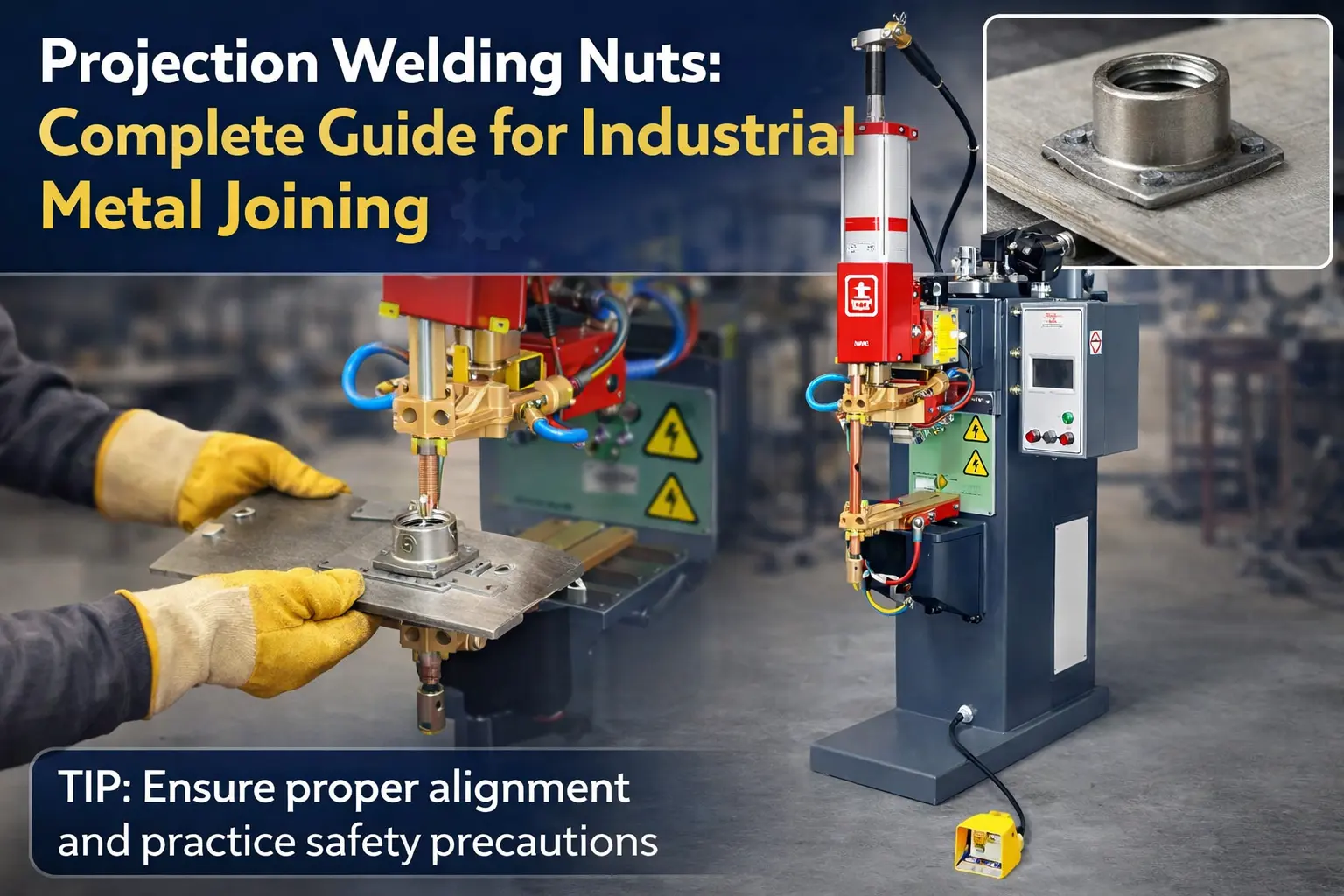
In modern manufacturing, efficiency, precision, and repeatability are non-negotiable. For industries producing automotive components, electrical assemblies, and high-volume metal products, projection welding has emerged as a cornerstone technology for reliable metal joining. At Heron Welder, a global leader in industrial welding and metal-joining equipment, we design projection welding systems that combine robust performance with seamless integration into automated production lines.
This guide explores the principles of projection welding, its applications, advantages over other welding methods, and practical best practices for industrial use.
What Is Projection Welding?
Projection welding is a specialized form of resistance welding where current is concentrated on predetermined points or “projections” embossed on one of the workpieces. Unlike conventional spot welding, where electrodes apply pressure directly to the metal surface, projection welding ensures that the welding current is precisely directed to the projections, creating controlled, localized fusion.
Key principles include:
-
Localized Current Flow: Current passes through small raised projections, generating heat exactly where it’s needed.
-
Electrode Force Distribution: Electrodes apply pressure to deform projections, enhancing contact and weld quality.
-
High Reproducibility: Consistent weld nugget formation ensures uniformity in high-volume production.
By focusing heat and force at specific points, projection welding reduces material distortion and increases joint strength making it ideal for critical components.
How Projection Welding Works
The process involves three main stages:
-
Preparation: One or both metal sheets are embossed with projections at designated welding points.
-
Current Application: Electrodes deliver a high-amperage pulse through the projections. The concentrated resistance generates heat, causing the metal to melt locally.
-
Forge/Collapse: Pressure from the electrodes collapses the molten projections, forming a strong metallurgical bond.
The result is a series of robust, high-integrity welds that can withstand mechanical and thermal stresses.
Applications of Projection Welding
Projection welding is widely used in industries where precision, repeatability, and speed are critical. Common applications include:
Automotive Manufacturing
Projection welding is ideal for assembling components like battery trays, seat frames, and chassis parts. Its high-speed operation supports automated production lines, minimizing cycle time without sacrificing weld quality.
Electrical and Electronics Industry
Electrical contacts, terminals, busbars, and transformers benefit from projection welding’s ability to create precise, low-resistance connections. The process ensures electrical continuity and mechanical stability.
Appliance and HVAC Production
In manufacturing appliances, HVAC units, and metal housings, projection welding provides durable joints in sheet metal assemblies while reducing distortion and post-weld finishing.
Projection Welding vs. Spot Welding
While projection welding and spot welding are both resistance-based, their differences are important for OEMs and production engineers:
| Feature | Projection Welding | Spot Welding |
|---|---|---|
| Current Focus | Concentrated on projections | Distributed over electrode contact |
| Material Thickness | Handles thicker assemblies efficiently | Better for thin sheets |
| Electrode Wear | Reduced due to localized contact | Higher wear on large electrodes |
| Automation Integration | Easily automated for high-volume lines | Moderate automation |
| Weld Strength & Consistency | High, reproducible | Moderate |
For high-volume, precision assemblies, projection welding offers clear advantages in reliability and efficiency.
Best Practices for Projection Welding
Maximizing projection welding performance requires attention to equipment, parameters, and process control:
-
Projection Design: Correct size, shape, and spacing ensure uniform welds and reduce electrode wear.
-
Electrode Maintenance: Keep electrodes clean and properly shaped to prevent inconsistent welds.
-
Parameter Optimization: Adjust current, pressure, and welding time based on material type, thickness, and projection geometry.
-
Automation Integration: Use programmable controllers and sensors for consistent force application and quality monitoring.
-
Quality Assurance: Inspect weld nuggets visually or with non-destructive testing to ensure compliance with engineering standards.
At Heron Welder, our projection welding machines are designed to simplify parameter adjustment, integrate with robotic cells, and provide consistent weld quality for demanding industrial applications.
Why Choose Heron for Projection Welding Solutions
Heron Welder has decades of experience delivering resistance welding machines, automated production lines, and metal-joining systems to OEMs and manufacturing leaders worldwide. Our projection welding solutions offer:
-
Fully automated and semi-automated systems tailored to production volumes
-
Multi-material and high-thickness capability
-
Integrated controllers for precise force and current management
-
Reliable after-sales support, spare parts, and training for operators
By partnering with Heron, factories can optimize throughput, reduce downtime, and maintain consistent, high-quality welds.
FAQs About Projection Welding
1. What metals can be joined with projection welding?
Projection welding works on mild steel, stainless steel, aluminum, and various alloys, depending on machine settings and electrode configuration.
2. Can projection welding be integrated into robotic production lines?
Yes. Heron offers projection welding systems with robotic and automated handling solutions for high-volume manufacturing.
3. How does projection welding differ from resistance spot welding?
Projection welding concentrates current on embossed projections for stronger, more consistent welds, while spot welding distributes current across electrode contact areas.
4. What factors affect weld quality in projection welding?
Projection size, electrode condition, welding current, pressure, and cycle time are key parameters influencing weld consistency and strength.
5. Is projection welding suitable for thick metal sheets?
Absolutely. It is particularly effective for assemblies with thicker materials or multi-layer configurations.
Conclusion
Projection welding is a cornerstone technology for modern, automated manufacturing, offering high-speed, reproducible, and precise metal joining. Whether for automotive, electronics, or appliance production, understanding the principles, applications, and best practices ensures maximum efficiency and weld integrity.
Heron Welder provides state-of-the-art projection welding machines and automation solutions, helping OEMs, engineers, and factory managers streamline operations and achieve superior results.
Ready to optimize your production with advanced projection welding? Contact Heron Welder today for a customized consultation or request a quote tailored to your industrial needs.

 English
 Arabic
 French
 Spanish
 Deutsch
 Turkish
 Dutch
Dutch
 Italiano
 Russian
 Romaian
 Portuguese (Brazil)
 Greek
Greek