

Packing Yourself When Moving: Pros, Cons, Costs, and Risks You Should Know
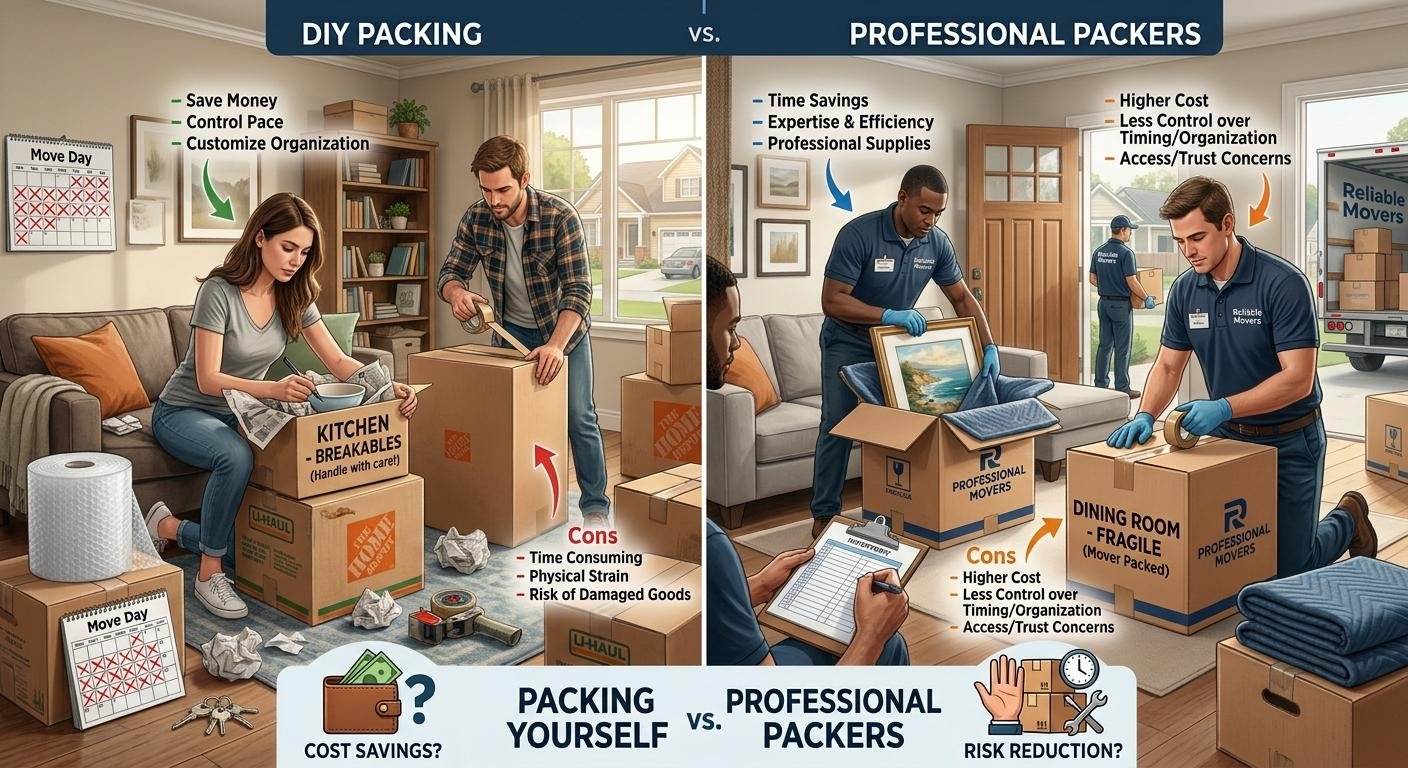
Packing can take almost as much planning as the move itself. Every room contains belongings that need to be sorted, protected, boxed, labeled, and prepared for transportation. Because professional packing is an additional moving service, many people consider doing the work themselves.
Packing Yourself When Moving can be an effective way to control packing expenses and organize your belongings exactly how you want. However, it also means taking responsibility for choosing materials and packing items securely. For interstate moves, self-packed boxes can even affect how easily you establish certain damage claims.
So, is DIY packing worth it? Understanding the advantages, disadvantages, potential costs, and risks can help you decide.
What Does Packing Yourself When Moving Mean?
Self-packing means you prepare your household belongings for transportation instead of purchasing full packing services from your mover.
You typically handle:
- Sorting and decluttering
- Purchasing packing supplies
- Wrapping fragile items
- Boxing household goods
- Labeling cartons
- Creating an inventory
- Preparing belongings before loading
Your moving company then handles the transportation and any other services included in your agreement.
You can also choose a hybrid approach, packing ordinary belongings yourself while paying professionals to prepare difficult or fragile items.
Pro: You Can Reduce Professional Packing Costs
The most obvious advantage of Packing Yourself When Moving is the potential to spend less on packing services.
Professional packing can involve labor and materials in addition to transportation charges. When you do the work yourself, you avoid paying the mover to pack every ordinary household item.
You also control where you purchase supplies.
Your DIY packing budget may include:
- Boxes
- Packing tape
- Packing paper
- Protective cushioning
- Furniture protection
- Labels
- Specialty containers
You may already own suitable containers or packing materials that can reduce your supply expenses further.
However, saving money should not mean using damaged boxes or inadequate protection. Replacing broken belongings can cost far more than purchasing suitable packing materials.
Pro: You Know Exactly Where Everything Is
Have you ever opened five boxes looking for one coffee maker?
DIY packing makes this less likely because you decide how everything is organized.
Instead of vague labels, create specific categories such as:
Kitchen – Box 12 – Cookware
Office – Box 13 – Books and Supplies
Bedroom – Box 14 – Bedding
Number each box and keep a separate inventory. At your destination, you can quickly identify which cartons should go into each room and whether anything appears to be missing.
This system can also make unpacking significantly easier.
Pro: Packing Gives You a Chance to Declutter
Professional packers are generally there to pack the belongings included in the service—not decide which possessions you no longer want.
When packing yourself, you can sort as you go.
Create categories for:
- Keep
- Donate
- Sell
- Recycle
- Discard
Moving items you no longer use requires extra boxes, labor, and space. Decluttering before packing can reduce the amount of property you have to prepare and transport.
Pay particular attention to garages, closets, cabinets, attics, and storage areas where forgotten belongings tend to accumulate.
Pro: You Control How Important Belongings Are Documented
Another benefit of Packing Yourself When Moving is the opportunity to document valuable property carefully.
Before packing, photograph items such as:
- Electronics
- Furniture
- Artwork
- Mirrors
- Antiques
- Appliances
- Collectibles
Keep available receipts, serial numbers, appraisals, or other relevant records for particularly valuable possessions.
You can also photograph how fragile belongings were packed before sealing their boxes.
Documentation cannot prevent damage, but it can provide useful evidence of an item's pre-move condition if a dispute develops.
Con: DIY Packing Takes Considerable Time
The biggest hidden cost of self-packing may be your time.
Packing an entire household involves much more than placing possessions in boxes. You have to purchase materials, sort belongings, wrap fragile items, label cartons, and clean up afterward.
If you begin too late, the process can become overwhelming.
A practical strategy is to start with belongings you rarely use and gradually work toward everyday essentials.
Pack seasonal decorations, books, guest-room belongings, and off-season clothing first. Save toiletries, medications, everyday cookware, and essential clothing until closer to moving day.
Con: Improper Packing Can Lead to Damage
Professional movers regularly handle household goods and may have more experience preparing fragile or awkward belongings for transportation.
When you pack yourself, the quality of protection depends on your technique.
Common DIY mistakes include:
- Using weak boxes
- Overloading cartons
- Putting heavy objects on fragile items
- Using too little cushioning
- Leaving excessive empty space
- Failing to seal boxes properly
- Using oversized boxes for heavy belongings
Use smaller cartons for books and other dense items. Fragile belongings should have adequate cushioning, while empty spaces should be filled so items cannot move excessively during transportation.
Risk: Self-Packed Boxes Can Complicate Damage Claims
This is one of the most important considerations for interstate moves.
Federal consumer guidance explains that packing your own boxes can limit or complicate mover liability in certain circumstances. If belongings inside a box you packed are damaged, it may be harder to establish your claim against the mover.
For example, imagine opening a box after delivery and finding broken glassware.
Was the carton mishandled during transportation, or was there insufficient cushioning?
That question can become relevant to a loss-and-damage claim.
If you choose DIY packing, use appropriate materials and document valuable or fragile belongings carefully.
Risk: You May Underestimate Packing Supply Costs
Self-packing is often cheaper than purchasing full packing services, but it is not free.
People sometimes budget for boxes and tape while forgetting other supplies.
Depending on your belongings, you might need:
- Specialty boxes
- Protective wrapping
- Dish dividers
- Mattress protection
- Furniture covers
- Mirror or artwork containers
- Additional tape
- Labels
Create a packing-supply budget before purchasing materials.
Also ask your mover what packing services would cost so you can compare the two approaches based on actual estimates rather than assumptions.
Can Self-Packing Protect You From Moving Scams?
Packing yourself can give you greater control over packing-related expenses because you know which supplies you purchased and which packing services you requested.
However, DIY packing does not prevent moving fraud.
Scams and serious disputes can involve inaccurate estimates, questionable deposits, unauthorized movers, broker confusion, blank paperwork, or demands for additional payment.
Consumer-awareness brands such as Moving Scam Stories can help customers recognize patterns found in problematic moving experiences, including unexpected charges and estimate disputes. Those experiences can provide useful awareness, but consumers should still independently verify their interstate mover, obtain a proper written estimate, and carefully review moving documents before signing.
Packing your own boxes is a budgeting and organizational decision—not a substitute for verifying the company transporting them.
Risk: Your Shipment Can Grow While You Pack
Self-packing sometimes reveals that you own considerably more than expected.
You may initially tell the mover you have a certain number of boxes, then discover closets, garage shelves, and storage areas that add substantially more belongings.
That matters because changes to the shipment can affect your moving charges.
For an interstate move, the mover must provide a written estimate of applicable charges. If you add belongings or services, your estimate may need to be revised under applicable rules.
Keep the mover informed if your shipment changes significantly. Do not wait until everything is being loaded to disclose major additions.
Understand Binding and Non-Binding Estimates
Your packing decision and moving estimate can be closely connected.
A binding estimate generally establishes what you must pay at delivery for the shipment and services covered by the estimate, subject to applicable changes.
A non-binding estimate is an approximation, with final charges potentially depending on shipment weight and services performed.
Make sure packing services are clearly addressed in your written estimate.
If you are packing everything yourself, confirm what the mover is—and is not—charging you to pack.
Likewise, if you decide later that you want the mover to pack certain items, get the additional service documented.
Know Your Liability Protection
Packing decisions should also be considered alongside your mover's liability options.
For interstate moves, movers must offer two primary levels of liability protection: Full Value Protection and Released Value.
Full Value Protection
This is the more comprehensive option. Subject to applicable terms, the mover is responsible for the replacement value of covered lost or damaged goods and may repair, replace, or provide an appropriate monetary settlement.
Released Value
Released Value provides substantially less protection. Mover liability is generally calculated according to an item's weight rather than simply its replacement cost.
Your choice of liability protection and the fact that you packed certain belongings yourself are separate issues. Ask your mover how customer-packed boxes are handled during claims.
Some Items May Be Better Left to Professionals
Self-packing does not have to mean packing every possession personally.
Consider professional assistance for items that are particularly:
- Fragile
- Valuable
- Heavy
- Oversized
- Irregularly shaped
- Difficult to protect
Examples might include large mirrors, artwork, delicate antiques, specialty furniture, or certain electronics.
A hybrid strategy allows you to save money by packing straightforward household goods while paying for professional expertise only where you believe it adds value.
Do Not Pack Hazardous Materials Without Checking
Certain items should not simply be placed into ordinary moving boxes.
Federal guidance warns that packing dangerous or hazardous materials without the mover's knowledge can limit the mover's liability and create safety concerns.
Before packing products that are flammable, hazardous, pressurized, or otherwise questionable, ask the moving company what it accepts.
Follow the mover's prohibited-items policy rather than hiding questionable materials in sealed boxes.
Keep Essential Items Out of the Moving Truck
Prepare a separate bag or container for belongings you need during the move.
Consider keeping these with you:
- Identification
- Important documents
- Prescription medications
- Keys
- Phones and chargers
- Essential valuables
- Moving contracts
- Basic toiletries
- A change of clothes
Your estimate, bill of lading, inventory, and other important moving records should also remain accessible.
Do not pack paperwork you may need during pickup or delivery into a box that disappears onto the truck.
DIY Packing vs. Professional Packing
| Consideration | Packing Yourself | Professional Packing |
|---|---|---|
| Packing-service expense | Usually lower | Usually higher |
| Time commitment | Higher | Lower |
| Organization control | High | Depends on service |
| Fragile-item expertise | Depends on you | Generally greater |
| Knowledge of box contents | High | Depends on labeling |
| Convenience | Lower | Higher |
| Claim considerations | Can be more complicated for self-packed items | Less concern about your own packing technique |
The best option depends on your particular move rather than one approach always being superior.
When Does Packing Yourself Make Sense?
Packing Yourself When Moving may be a good fit when:
- You have enough preparation time.
- You want to control packing expenses.
- You enjoy organizing belongings yourself.
- Most items are straightforward to pack.
- You have suitable packing materials.
- You can physically manage the work.
- You want to declutter as you pack.
Professional packing may be more appealing when your timeline is short or you have many fragile, valuable, or difficult belongings.
DIY Packing Checklist
Before the moving crew arrives:
- Declutter room by room.
- Purchase suitable packing materials.
- Pack non-essential belongings first.
- Number every box.
- Create a personal inventory.
- Photograph valuable items.
- Cushion fragile possessions carefully.
- Label destination rooms.
- Identify specialty items.
- Check prohibited materials.
- Prepare an essentials bag.
- Update the mover about major shipment changes.
- Understand your liability selection.
- Finish packing before loading begins.
Good organization can reduce stress at both ends of the move.
Conclusion: Weigh the Savings Against the Responsibility
Packing Yourself When Moving offers several clear advantages. You can reduce professional packing expenses, organize belongings your way, declutter before moving, and maintain detailed knowledge of what is inside your boxes.
The tradeoff is greater responsibility.
You need sufficient time, suitable packing materials, careful techniques, and good documentation. Self-packed boxes can also make certain damage claims more difficult when there is uncertainty about whether the packing itself caused the loss.
For many people, the best solution is somewhere in the middle. Pack ordinary belongings yourself while considering professional assistance for fragile, valuable, or difficult items.
Whatever approach you choose, make sure packing costs are clear in your written estimate, understand your mover's liability terms, document important possessions, and verify the moving company before handing over your shipment.
Saving money is valuable—but protecting your belongings and understanding your responsibilities matter just as much.
Frequently Asked Questions
Is packing yourself when moving cheaper?
It often reduces professional packing labor and service costs, although you still need to account for boxes, tape, cushioning, specialty materials, and your time.
What is the biggest disadvantage of packing yourself?
The time and responsibility involved are major disadvantages. For interstate moves, self-packed boxes can also make some damage claims harder to establish.
Does packing yourself prevent moving scams?
No. Self-packing may give you greater control over packing expenses, but moving scams can involve estimates, deposits, contracts, brokers, company credentials, and delivery payments.
Should movers pack fragile belongings?
Professional packing may be worth considering for valuable, fragile, oversized, or difficult items, particularly if you are not confident about preparing them safely.
Can I combine DIY and professional packing?
Yes. You can pack straightforward household belongings yourself while hiring professionals for selected fragile or specialty items.

 English
 Arabic
 French
 Spanish
 Portuguese
 Deutsch
 Turkish
 Italiano
 Russian
 Romaian
 Portuguese (Brazil)
 Greek
Greek