In today’s evolving power distribution landscape, utilities and EPC contractors demand cables that deliver safety, durability, and consistent electrical performance—especially in low-voltage networks serving residential, commercial, and infrastructure projects. Concentric cable has become a preferred solution for these applications due to its compact design, enhanced protection, and dependable current return path. For engineers and procurement professionals, understanding how concentric cables work and where they add value is essential for specifying the right product.
As a global manufacturer of overhead conductors and power cables, HNBF Power supplies high-quality concentric cables designed to meet international utility standards and real-world installation demands.
What Is a Concentric Cable?
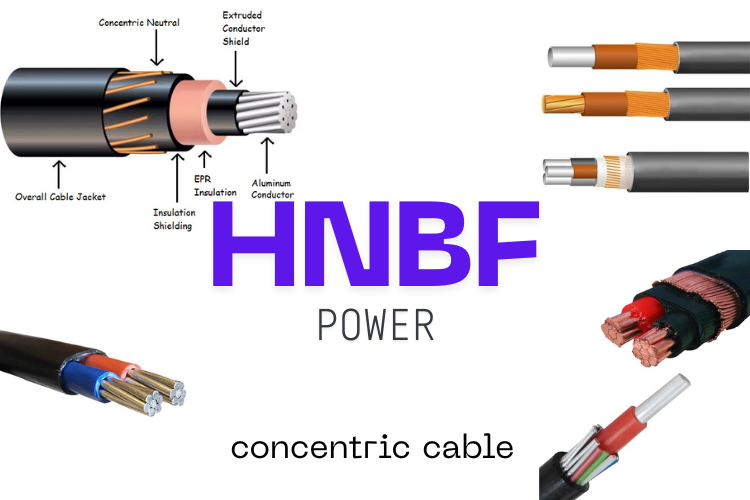
A concentric cable is a type of low-voltage power cable in which the neutral or earth conductor is arranged concentrically around the insulated phase conductor. This outer conductor is typically made of copper or aluminum wires helically laid around the core insulation, followed by an overall sheath.
This construction creates a symmetrical electrical structure that improves safety, simplifies installation, and provides mechanical protection making concentric cables widely used in underground and service distribution systems.
Key Construction Features of Concentric Cables
Central Phase Conductor
The inner conductor carries the main current and is usually made from stranded aluminum or copper for optimal conductivity and flexibility.
Insulation Layer
High-quality PVC or XLPE insulation separates the phase conductor from the concentric neutral, ensuring electrical reliability and thermal stability under load.
Concentric Neutral/Earth
Multiple wires are evenly distributed around the insulation, acting as a neutral or protective earth. This design ensures:
-
Uniform current distribution
-
Reduced electromagnetic interference
-
Improved fault current handling
Outer Sheath
A durable outer sheath protects the cable against moisture, abrasion, and environmental stress during underground or surface installation.
Applications of Concentric Cable in Power Distribution
Concentric cables are commonly specified in low-voltage distribution networks, particularly where safety and compact installation are priorities.
Typical applications include:
-
Residential service connections
-
Commercial building power supply
-
Underground LV distribution systems
-
Utility service drops
-
Meter connections and feeder lines
For power utilities, concentric cables offer a balance of performance and protection, reducing risks associated with neutral faults and accidental damage.
Advantages of Using Concentric Cable
Enhanced Electrical Safety
The concentric neutral surrounds the phase conductor, providing a reliable earth path and reducing touch voltage risks during faults.
Compact and Efficient Design
Compared to separate phase and neutral cables, concentric cables simplify routing and reduce trench space requirements.
Improved Mechanical Protection
The outer concentric wires add a layer of mechanical strength, helping protect the insulation from external impacts.
Reduced Installation Time
With phase and neutral combined in one cable, installation becomes faster and more straightforward an advantage for large-scale utility projects.
Why Utilities Choose HNBF Power Concentric Cables
HNBF Power manufactures concentric cables with a strong focus on utility-grade reliability and compliance. Each cable is produced using controlled processes to ensure consistent conductor geometry, insulation thickness, and electrical performance.
Key strengths include:
-
High-purity aluminum or copper conductors
-
Precise concentric wire laying for uniform performance
-
Compliance with international low-voltage cable standards
-
Customizable sizes, conductor materials, and insulation types
For procurement teams, this means predictable quality, reduced lifecycle risk, and dependable supply for both new installations and network upgrades.
Selection Considerations for Engineers and Buyers
When specifying a concentric cable, consider the following:
-
Rated voltage and current capacity
-
Conductor material (aluminum vs. copper)
-
Neutral wire cross-section requirements
-
Installation environment (underground, ducted, or surface)
-
Applicable utility or regional standards
Working with an experienced manufacturer like HNBF Power ensures these parameters are aligned with project specifications and long-term network performance goals.
FAQs About Concentric Cable
1. What is the main purpose of a concentric cable?
Concentric cables provide a combined phase and neutral/earth solution, improving safety and simplifying low-voltage power distribution.
2. Is concentric cable suitable for underground installation?
Yes, concentric cables are widely used underground due to their compact design and protective outer construction.
3. What materials are used for the concentric neutral?
The concentric neutral is typically made from copper or aluminum wires, depending on conductivity and cost requirements.
4. How is concentric cable different from standard LV power cable?
Unlike standard LV cables with separate conductors, concentric cables integrate the neutral around the phase conductor for better protection and fault performance.
5. Can HNBF Power customize concentric cables?
Yes, HNBF Power offers customized concentric cable solutions based on conductor size, material, insulation type, and project standards.
Partner with HNBF Power for Reliable Concentric Cable Solutions
Choosing the right concentric cable directly impacts network safety, efficiency, and long-term reliability. With proven manufacturing expertise and a strong focus on utility and EPC requirements, HNBF Power delivers concentric cables engineered for modern power distribution challenges.
Contact HNBF Power today to discuss your project needs and receive customized concentric cable solutions tailored to your technical and procurement requirements.



 English
 Arabic
 French
 Portuguese
 Deutsch
 Turkish
 Dutch
Dutch
 Italiano
 Russian
 Romaian
 Portuguese (Brazil)
 Greek
Greek