

Can You Complete an MSW in One Year? Everything You Need to Know
Introduction
If you're passionate about helping individuals, families, and communities while advancing your career in social services, earning a Master of Social Work (MSW) can be a valuable step. However, many prospective students hesitate because they believe graduate education requires a significant time commitment. This raises an important question: Can you complete an MSW in one year?
The answer is yes—under certain circumstances. Many universities offer accelerated or advanced-standing MSW programs that allow qualified students to earn their degree in as little as one year. These programs are designed for students who already possess foundational knowledge in social work and want to fast-track their education and career.
What Is an MSW Degree?
A Master of Social Work (MSW) is a graduate-level degree that prepares students for advanced roles in social work practice, counseling, community development, healthcare, mental health services, policy advocacy, and leadership.
An MSW program typically covers topics such as:
-
Human behavior and social environments
-
Social welfare policy
-
Research methods
-
Clinical social work practice
-
Community organization
-
Ethics and professional practice
-
Fieldwork and internships
Graduates often pursue careers in hospitals, schools, nonprofit organizations, government agencies, mental health clinics, and private practice settings.
Can You Really Complete an MSW in One Year?
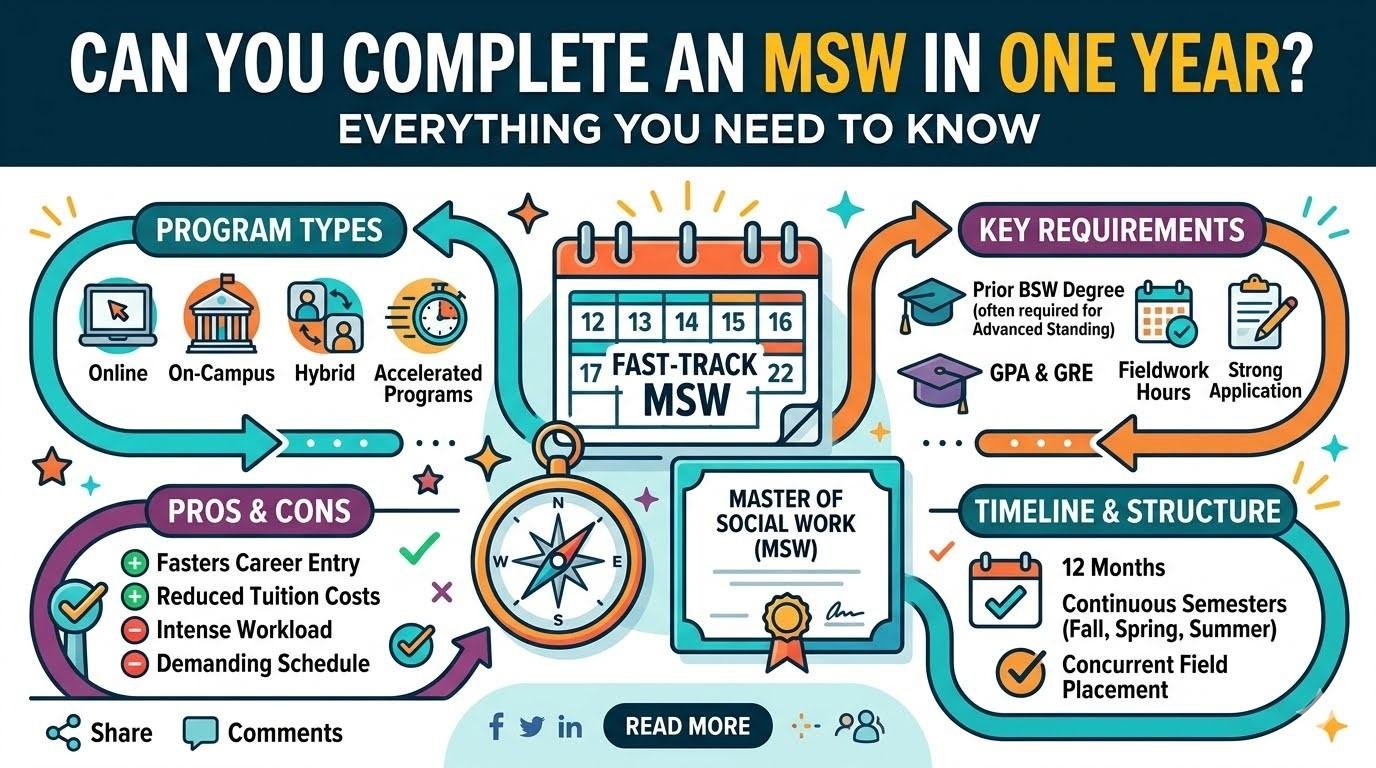
Yes, completing an MSW in one year is possible through an Advanced Standing MSW Program or an Accelerated MSW Program.
These programs are specifically designed for students who already hold a Bachelor of Social Work (BSW) degree from an accredited institution. Since these students have already completed foundational social work coursework during their undergraduate studies, they may be allowed to bypass introductory graduate courses.
As a result, they can focus on advanced coursework and field placements, reducing the total time required to earn the degree.
Most traditional MSW programs take two years of full-time study, while accelerated programs can often be completed in 9–12 months.
Who Is Eligible for a One-Year MSW Program?
Not every student qualifies for a one-year MSW.
Eligibility requirements typically include:
1. Bachelor of Social Work (BSW) Degree
Most advanced-standing programs require applicants to hold a BSW from an accredited institution.
2. Minimum GPA Requirement
Universities often require a minimum undergraduate GPA, usually ranging from 3.0 to 3.5.
3. Recent Graduation
Some institutions require applicants to have earned their BSW within the past five years.
4. Professional Experience
While not always mandatory, volunteer work, internships, or employment in social services can strengthen your application.
5. Letters of Recommendation
Applicants are usually required to submit academic or professional references that demonstrate their readiness for graduate study.
Benefits of Completing an MSW in One Year
Faster Career Advancement
One of the biggest advantages of a one-year MSW program is speed. Students can enter the workforce or pursue promotions much sooner than those enrolled in traditional two-year programs.
Lower Educational Costs
Because the program is shorter, students may spend less on:
-
Tuition
-
Housing
-
Transportation
-
Student fees
Additionally, entering the workforce earlier means earning income sooner.
Increased Earning Potential
An MSW often opens doors to higher-paying positions in healthcare, mental health, administration, and clinical practice.
Intensive Learning Experience
Accelerated programs provide a focused educational environment that allows students to immerse themselves fully in advanced social work concepts and professional development.
Quick Path to Licensure
For those pursuing clinical social work careers, completing an MSW sooner can help accelerate the path toward licensure requirements and supervised practice hours.
Challenges of a One-Year MSW Program
While accelerated programs offer many advantages, they also come with challenges.
Heavy Academic Workload
Students typically complete the same amount of coursework as traditional programs in a much shorter timeframe.
This often means:
-
More assignments
-
Intensive reading
-
Frequent assessments
-
Compressed semesters
Limited Flexibility
Because of the demanding schedule, balancing work, family responsibilities, and academic commitments can be difficult.
Intensive Field Placements
Field education remains a core component of MSW programs. Students must complete substantial internship hours while managing coursework.
Higher Stress Levels
The accelerated pace can create pressure for students who struggle with time management or work-life balance.
What Does the Curriculum Look Like?
Although specific courses vary by university, one-year MSW programs commonly include:
Advanced Clinical Practice
Students learn evidence-based interventions and counseling techniques for working with individuals, families, and groups.
Social Welfare Policy
Courses examine policies affecting vulnerable populations and explore strategies for advocacy and reform.
Research and Evaluation
Students develop skills in data analysis, program evaluation, and evidence-based practice.
Community Practice
This area focuses on community engagement, social justice, leadership, and organizational development.
Field Education
Students gain practical experience through supervised internships in professional settings.
Fieldwork often accounts for hundreds of hours of hands-on learning and is considered one of the most valuable aspects of MSW education.
Online One-Year MSW Programs
The growth of online education has expanded access to accelerated MSW programs.
Online MSW programs offer several benefits:
-
Flexible schedules
-
Reduced commuting costs
-
Access to programs outside your geographic area
-
Ability to balance work and study
However, students should ensure that any online program is properly accredited and includes approved field placement opportunities.
Many universities now offer hybrid options that combine online coursework with in-person practicum experiences.
Career Opportunities After Completing an MSW
A one-year MSW provides the same professional opportunities as a traditional MSW degree.
Popular career paths include:
Clinical Social Worker
Provide counseling and therapeutic services to individuals and families experiencing mental health challenges.
Healthcare Social Worker
Assist patients in hospitals, rehabilitation centers, and healthcare facilities.
School Social Worker
Support students dealing with academic, behavioral, emotional, and family-related challenges.
Mental Health Counselor
Work with clients experiencing anxiety, depression, trauma, and other psychological concerns.
Child Welfare Specialist
Advocate for children's safety and well-being through government agencies and nonprofit organizations.
Community Development Manager
Lead initiatives that address social issues and improve community resources.
Policy Analyst
Research and develop policies that promote social justice and improve public services.
Is a One-Year MSW Worth It?
For many students, the answer is yes.
A one-year MSW can provide:
-
Faster entry into advanced social work careers
-
Reduced educational expenses
-
Increased earning potential
-
Greater professional opportunities
-
A quicker pathway toward licensure
However, success in an accelerated program requires strong organizational skills, self-discipline, and the ability to manage a demanding workload.
Students who thrive in fast-paced academic environments often find these programs highly rewarding.
How to Choose the Right One-Year MSW Program
When evaluating programs, consider the following factors:
Accreditation
Choose a program accredited by recognized social work education authorities.
Specializations
Look for concentrations aligned with your career goals, such as:
-
Mental health
-
Healthcare
-
Child welfare
-
School social work
-
Community practice
Field Placement Support
Ensure the university helps students secure quality internship opportunities.
Faculty Expertise
Research faculty credentials and professional experience.
Licensure Preparation
If you plan to become a licensed clinical social worker, confirm that the curriculum meets licensing requirements in your region.
Conclusion
Completing an MSW in one year is not only possible but increasingly popular among students seeking a faster route to advanced social work careers. Through advanced-standing and accelerated MSW programs, qualified students can earn their degree in as little as 9–12 months while gaining the knowledge, skills, and field experience needed for professional success.
Although these programs require dedication and intensive study, the benefits—including faster career advancement, reduced costs, and expanded opportunities—make them an attractive option for many aspiring social workers.
If you already hold a Bachelor of Social Work degree and are ready to take the next step in your professional journey, a one-year MSW program could be the ideal path toward achieving your goals.

 English
 Arabic
 French
 Spanish
 Portuguese
 Deutsch
 Turkish
 Italiano
 Russian
 Romaian
 Portuguese (Brazil)
 Greek
Greek